

LinearTrend#
- class pymc_marketing.mmm.linear_trend.LinearTrend(**data)[source]#
LinearTrend class.
Linear trend component using change points. The trend is defined as:
\[f(t) = k + \sum_{m=0}^{M-1} \delta_m I(t > s_m)\]where:
\(t \ge 0\),
\(k\) is the base intercept,
\(\delta_m\) is the change in the trend at change point \(m\),
\(I\) is the indicator function,
\(s_m\) is the change point.
The change points are defined as:
\[s_m = \frac{m}{M-1} T, 0 \le m \le M-1\]where \(M\) is the number of change points (\(M>1\)) and \(T\) is the time of the last observed data point.
The priors for the trend parameters are:
\(k \sim \text{Normal}(0, 0.05)\)
\(\delta_m \sim \text{Laplace}(0, 0.25)\)
- Parameters:
- priors
dict[str,Prior], optional Dictionary with the priors for the trend parameters. The dictionary must have ‘delta’ key. If
include_interceptis True, the ‘k’ key is also required. By default None, or the default priors.- dims
Dims, optional Dimensions of the parameters, by default None or empty.
- n_changepoints
int, optional Number of changepoints, by default 10.
- include_interceptbool, optional
Include an intercept in the trend, by default False
- prefix
str, optional Prefix for the changepoint coordinate and parameter names, to avoid name collisions when multiple
LinearTrendinstances are used in the same model. By default “”, which uses the unprefixed names.
- priors
References
- Adapted from MBrouns/timeseers package:
Examples
Linear trend with 10 changepoints:
from pymc_marketing.mmm import LinearTrend

trend = LinearTrend(n_changepoints=10)
Use the trend in a model:
import pymc as pm
import numpy as np

import pandas as pd

n_years = 3
n_dates = 52 * n_years
first_date = "2020-01-01"
dates = pd.date_range(first_date, periods=n_dates, freq="W-MON")
dayofyear = dates.dayofyear.to_numpy()
t = (dates - dates[0]).days.to_numpy()
t = t / 365.25

coords = {"date": dates}
with pm.Model(coords=coords) as model:
    intercept = pm.Normal("intercept", mu=0, sigma=1)
    mu = intercept + trend.apply(t)

    sigma = pm.Gamma("sigma", mu=0.1, sigma=0.025)

    pm.Normal("obs", mu=mu, sigma=sigma, dims="date")
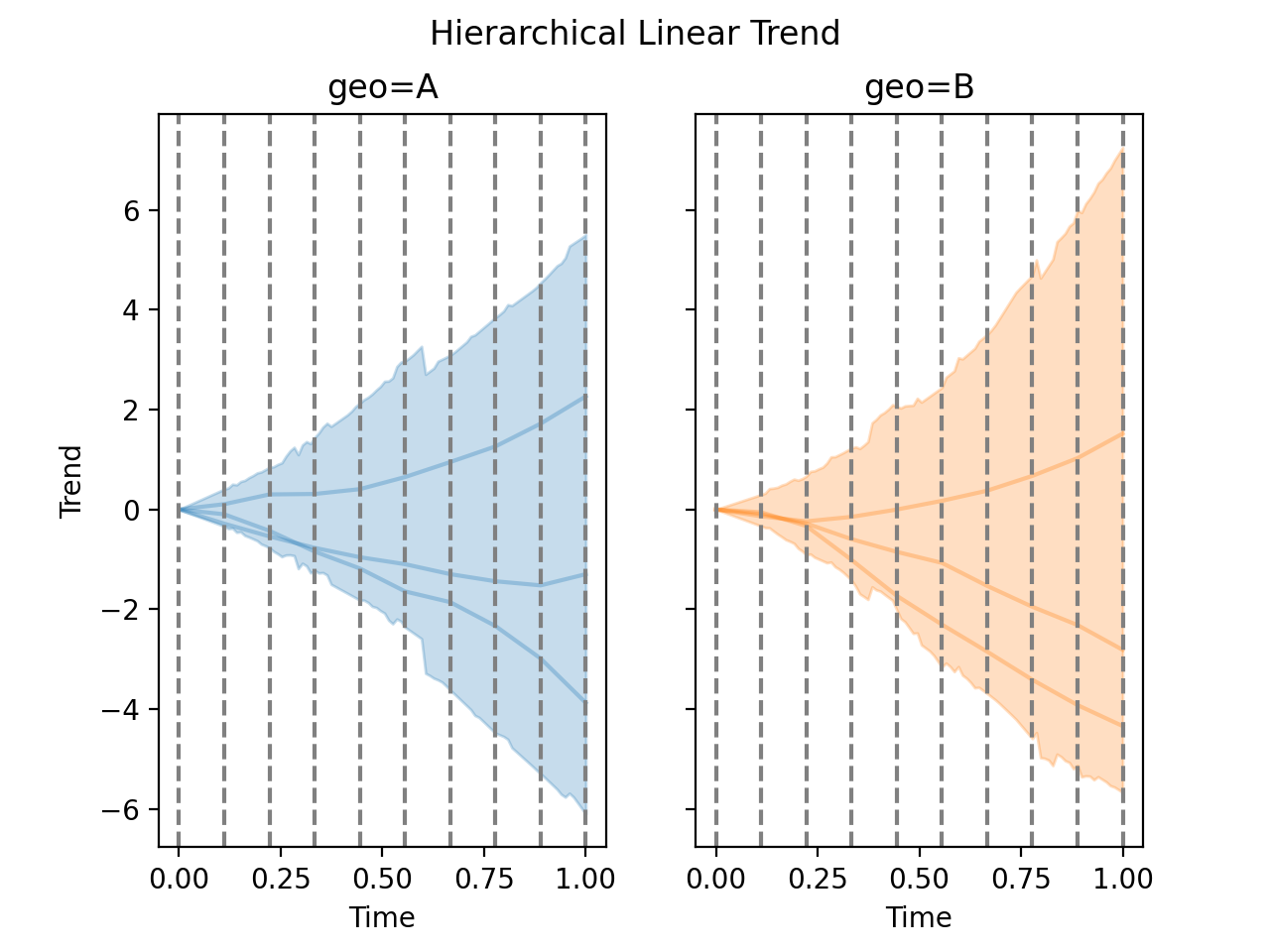
Hierarchical LinearTrend via hierarchical prior:
from pymc_extras.prior import Prior

hierarchical_delta = Prior(
    "Laplace",
    mu=Prior("Normal", dims="changepoint"),
    b=Prior("HalfNormal", dims="changepoint"),
    dims=("changepoint", "geo"),
)
priors = dict(delta=hierarchical_delta)

hierarchical_trend = LinearTrend(
    priors=priors,
    n_changepoints=10,
    dims="geo",
)
Sample the hierarchical trend:
seed = sum(map(ord, "Hierarchical LinearTrend"))
rng = np.random.default_rng(seed)

coords = {"geo": ["A", "B"]}
prior = hierarchical_trend.sample_prior(
    coords=coords,
    random_seed=rng,
)
curve = hierarchical_trend.sample_curve(prior)
Plot the curve HDI and samples:
fig, axes = hierarchical_trend.plot_curve(
    curve,
    n_samples=3,
    random_seed=rng,
)
fig.suptitle("Hierarchical Linear Trend")
axes[0].set(ylabel="Trend", xlabel="Time")
axes[1].set(xlabel="Time")
Methods
LinearTrend.__init__(**data)Create a new model by parsing and validating input data from keyword arguments.
Create the linear trend for the given x values.
LinearTrend.construct([_fields_set])LinearTrend.copy(*[, include, exclude, ...])Returns a copy of the model.
LinearTrend.dict(*[, include, exclude, ...])LinearTrend.from_dict(data)Reconstruct from a dict.
LinearTrend.from_orm(obj)LinearTrend.json(*[, include, exclude, ...])Compute the class name for parametrizations of generic classes.
LinearTrend.parse_file(path, *[, ...])LinearTrend.parse_raw(b, *[, content_type, ...])LinearTrend.plot_curve(curve[, n_samples, ...])Plot the curve samples from the trend.
LinearTrend.sample_curve(parameters[, max_value])Sample the curve given parameters.
LinearTrend.sample_prior([coords])Sample the prior for the parameters used in the trend.
LinearTrend.schema([by_alias, ref_template])LinearTrend.schema_json(*[, by_alias, ...])LinearTrend.to_dict([_orig])LinearTrend.update_forward_refs(**localns)LinearTrend.validate(value)Attributes
default_priorsDefault priors for the trend parameters.
model_computed_fieldsmodel_configConfiguration for the model, should be a dictionary conforming to [
ConfigDict][pydantic.config.ConfigDict].model_extraGet extra fields set during validation.
model_fieldsmodel_fields_setReturns the set of fields that have been explicitly set on this model instance.
priorsdimsn_changepointsinclude_interceptprefix